You have something to say... but you wait.
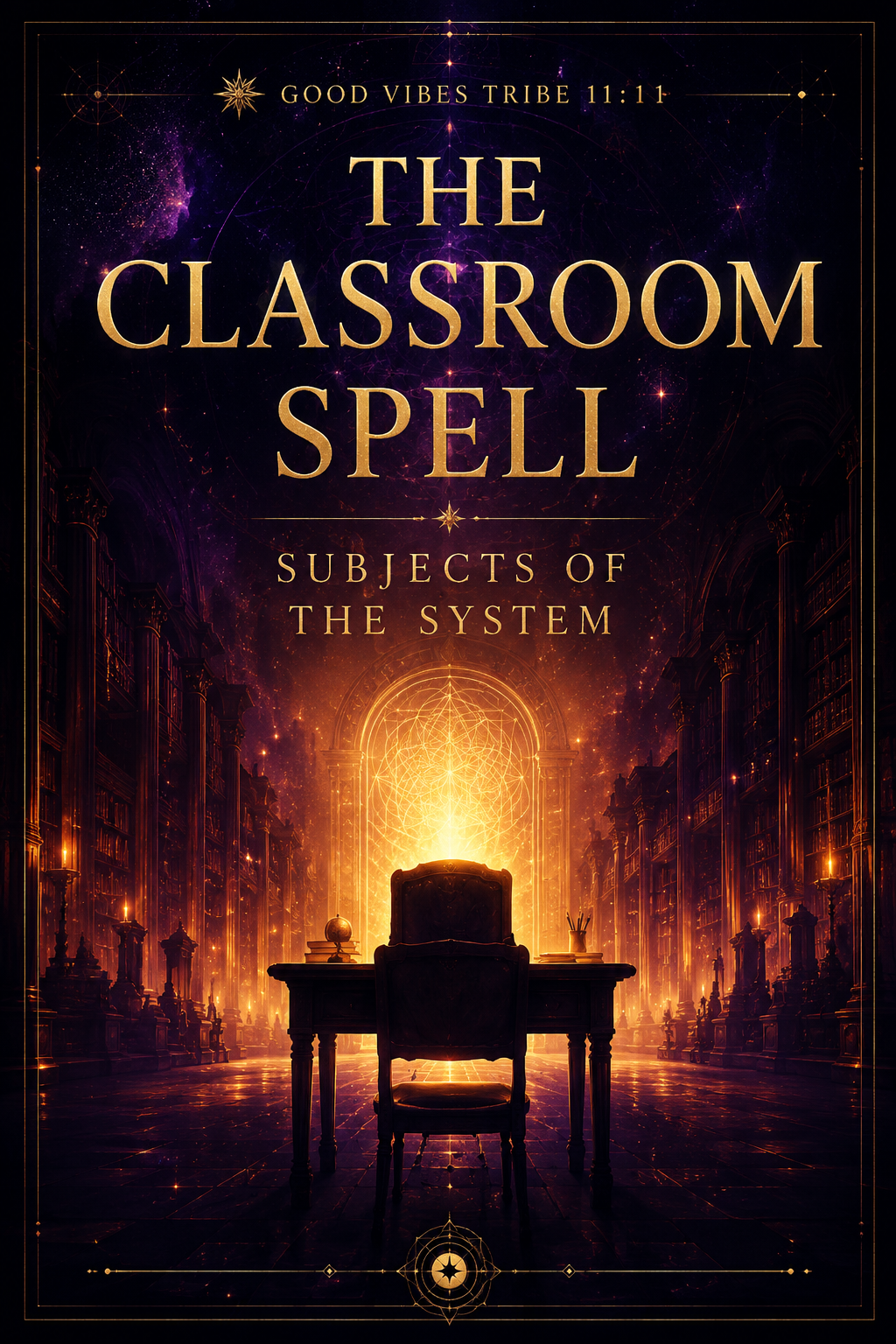
DIGITAL E-BOOK • $11.11
GOOD VIBES TRIBE 11:11
THE CLASSROOM SPELL
Subjects of the System.
You left the classroom. But did the classroom leave you?
Nobody asks you to raise your hand anymore.
Nobody gives you a grade for being yourself.
Nobody rings a bell telling you when to move.
And yet some of those patterns may still
be showing up in adult life.
THE QUESTION AT THE HEART OF THE BOOK
Is this growing my light
or shrinking my light?
DIGITAL E-BOOK
$11.11
GET THE CLASSROOM SPELL
→
✦ 43 pages
✦ 11 chapters
✦ Digital download
✦ Yours to revisit
MAYBE YOU'VE FELT THIS BEFORE
Some classrooms follow us home.
Not as desks and chalkboards. As patterns.
You know what you want... but still look around for confirmation.
You make a mistake... and suddenly it feels personal.
You finally rest... but part of you still feels behind.
Someone labeled you years ago... and somehow the name followed you.
You hear yourself asking... "Am I doing this right?"
AND THEN COMES THE QUESTION
Where did that voice come from?
What if some of the rules you live by were never consciously chosen?
THE CLASSROOM SPELL
This book is not asking you what happened in school. It asks what followed you out.
The Classroom Spell invites you to look at familiar experiences through a new lens and notice where permission, approval, labels, evaluation, authority, and external measurement may still appear in the way you move through life today.
SEE WHAT'S INSIDE ↓
INSIDE THE BOOK
You may never look at these the same way again.
Familiar experiences become mirrors for patterns that may still be moving through adult life.
Permission
What happens when waiting to be called on becomes waiting for permission to speak, move, create, or decide?
Where am I still waiting to be chosen?
Evaluation
When did a score stop being information and start feeling like evidence about who you are?
Who is grading me now?
Identity
Shy. Difficult. Gifted. Slow. Disruptive. Too quiet. Too much. What happens when a description becomes an identity?
Is this my name or something I inherited?
Time
Move. Stop. Hurry. You're late. Time's up. How much of adult urgency feels strangely familiar?
Why do I feel behind?
Authority
Structure can support us. But what happens when following becomes automatic agreement?
Did I consciously choose this?
Authorship
What changes when the question stops being "What am I supposed to say?" and becomes: "What do I actually know?"
What does my voice sound like when it is mine?
START LOOKING CLOSER
43 pages. 11 chapters. One question that may stay with you.
$11.11
GET THE CLASSROOM SPELL
→
✦
THE LIGHT CHECK
You don't need someone else to tell you what to think.
The book gives you another way to examine what you already carry.
ASK YOURSELF
Is this growing my light
or shrinking my light?
Where did this come from? Who or what introduced this idea into my world?
What does it create in me? What happens when I continue carrying it?
What do I consciously choose? What belongs in the life I am creating now?
THIS MATTERS
This isn't about hating school.
You do not have to reject everything you were given.
You do not have to decide that every system, teacher, structure, or experience was wrong.
And you do not have to agree with every interpretation in this book.
THE INVITATION IS SIMPLER
Look at what you carry.
Where did it come from?
What does it create in me?
Does it grow my light?
THE EXPERIENCE
What do you actually get?
A short read designed to create a much longer conversation with yourself.
43
PAGES
Focused enough to move through without feeling like homework.
11
CHAPTERS
Each opens a different doorway into language, identity, and conditioning.
1
QUESTION
A question you can carry long after the final page.
THE VALUE IS WHAT HAPPENS AFTER
You don't finish this book with more information. You finish it with better questions.
Whose voice is this?
When did I start carrying this?
Am I choosing this or repeating it?
What does this belief create in my life?
Does this grow my light?
WHY $11.11?
Some books give you more information. This one asks you to look differently at information you've carried for years.
I priced The Classroom Spell at $11.11 because I want this question to be easy to access.
YOU AREN'T BUYING 43 PAGES.
You're buying the questions
you may start asking after them.
THE CLASSROOM SPELL
$
11.11
One-time purchase
- ✓ Complete 43-page digital book
- ✓ All 11 chapters
- ✓ Digital download
- ✓ Yours to keep
BEFORE YOU ENTER
Quick questions.
Is this book saying school is evil?
No. The deeper focus is awareness. The book explores how repeated environments, language, evaluation, authority, and social expectations can influence the way we think and behave. You are invited to examine those ideas for yourself.
Do I need to agree with everything in the book?
No. The book is designed to provoke examination, reflection, and discernment. You decide what resonates, what you question, and what you consciously choose.
Is this only relevant if I had a bad school experience?
No. Many of the book's themes relate to familiar experiences like grades, permission, labels, approval, schedules, authority, and speaking up. The question is simply whether any of those patterns still appear in your life today.
Is this a physical book?
No. The Classroom Spell is a digital e-book delivered through the GVT store.
How do I receive it after purchasing?
Once checkout is completed, your digital download will be made available through the store's order and download system.
NOTICE • DISCERN • CHOOSE
You were given a lot of answers before you knew you could question them.
Names. Rules. Expectations. Definitions. Ideas about success. Ideas about failure. Ideas about who you were supposed to become.
Now you get to look again.
ASK YOURSELF
Does this grow my light?
$11.11
GET THE CLASSROOM SPELL
→
THE CLASSROOM SPELL
Digital E-Book • $11.11
